Clapham Manual Therapy and Functional Movement

Cold Water Swimming

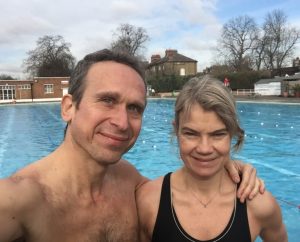
Jack and Sue McCall cold water swimming at Brockwell Lido

This January, Jack and I started to take a weekly dip at Brockwell Park Lido in water temperatures ranging between 2.4 and 9 degrees C, followed by 20 minutes or so in the cute wood-burning sauna that has been installed poolside. This has become an essential part of our winter survival, with boosts to both physical and mental well-being. The actual swim is tough, the cold triggering a burning pain in the extremities and an intense desire to get out.  However, we are gradually increasing the distance we can swim and time in the pool (about 20 minutes now). The best moment is about 30 seconds after exiting the pool when the endorphins kick in and you feel great – even better on a sunny day!
Read More

Eight in 10 middle-aged Britons ‘are overweight or exercise too little’

overweight-britons
image courtesy of The Guardian

Did you know that back in the 19th century type II diabetes affected around 1 in 30,000 people, now it is up to 1 in 3. As this article discusses this is a serious disease. However, in most cases, it is completely preventable by lifestyle changes. On a simplistic level, It is a problem of excess sugar, we eat so much more than our ancestors ever did, and we’re not moving so this glucose is going straight to our fat cells or staying in the blood damaging the arteries.


Read the full article in The Guardian.

10 myths about back pain and how to cope when it strikes

back-pain
image courtesy of Independent.IE

This is a very informative article which deals with many common misconceptions about back pain, including the idea that it is usually an indication of damage (it is not) or that the back is fragile. It is incredibly strong and designed for bending and lifting. Often pain is triggered by something minor such as twisting or bending down. In this case, it is likely due to repetitive poor movement patterns (which can be changed) or sensitization of the nervous system due to other factors such as poor sleep, stress or previous unresolved injury to knee or ankle. If you are suffering from back pain that doesn’t resolve after a few days, make sure to see a therapist who will consider all of the contributing factors. If you’re in London we would love to see you at Backs Etc. to put together a treatment and movement training program to get you back on your feet.

Read the full article 10 myths about back pain and how to cope when it strikes.

Why you should consider going barefoot

barefoot-1149848_1920I recently attended the Barefoot Training Specialist course with Dr Emily Splichal.  You may ask why such a course is necessary – if you want to go barefoot surely all you need to do is take your shoes off, or buy a pair of those strange Vibram five finger shoes and then just get on with it.  However, if you have spent most of your life wearing stiff, vibration-damping casts on your feet, AKA ‘normal shoes’, then you need to do some work to get your body ready for going barefoot. Remember that each foot contains 26 bones (a quarter of all the bones in the body) along with 33 joints and over 100 muscles and tendons, so it’s not an inanimate slab, but a highly adaptable, active base that allows us to move across all types of terrain. Feet actually need the sensory input and movement provided by the varying surfaces and slopes of the ground in order to be healthy. Wearing conventional shoes can be analogised to wearing a plaster cast on a limb for several months. At the end of that period, the limb is both muscularly weak, and neurologically deficient from the lack of stimulation.  As this Guardian article shows, learning to strike forefoot and using minimalist shoes reduces injuries. So even if you have no intention of going barefoot, but you want to avoid or get rid a plethora of lower extremity issues such as shin splints or Achilles tendon problems, then read on.

Read More

Foot Health and Exercises

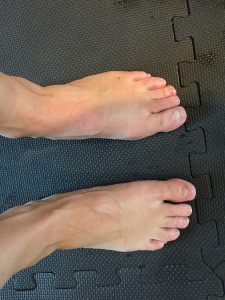
2015-03-09 11.34.01Some great and practical advice about foot health and how to avoid orthotics. I wear ‪correct toes‬ most days to everyone else’s amusement. I also rarely wear anything other than minimal footwear and try to exercise my feet every day. My arches are improving and my toes are spreading back to their natural shape. Compressive shoes combined with poor gait mechanics are a major source of bunions, it is much easier to prevent these at an early stage rather than trying to correct a fully formed bunion.

To get the full article click here.

Prevention of Running Injuries


well_running-superJumbo

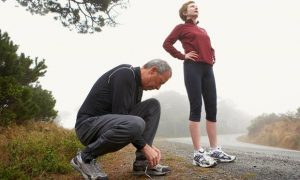
This article shows that a conscious effort to land more lightly whilst ‪running decreases the risk of injury. This make take the form of make a conscious effort to land more lightly using heel strike,  or moving to a fore or mid-foot running style as it is harder to land heavily on the ball of the foot.  As an experiment try running a short distance barefoot, landing too heavily will be very painful and so this can give you an indication of where and how you should be landing whilst wearing shoes.  A light stride also indicates that you have more control over your limbs, it is important to build core and hip stability for running to maximise control and enable the proper use of your arms to propel you forward.

For the full article click here.

Restorative Exercise

restorative exercise

I often give restorative exercises to patients, which are often seen as simple and regressed. Most people need some persuasion to substitute these for their hardcore training regime for a while. But I try to liken it to literacy, your body needs to be able to do the movement basics well – that is learn your letters and words, before you can perform the novel that is running a marathon, playing football or dead-lifting 120kg. So many of us have lost basic movement literacy and fluidity, and this is the root of much musculoskeletal pain.

You can read the full article here.

Barefoot shoes and advice for transitioning

An interesting discussion of ‪#‎barefoot‬ shoes and training and some exercises and ideas on how to make the transition and what to look for in a shoe that will support our foot and overall health. Wearing most conventional, stiff shoes is like wearing a cast and causes the muscles and joints in your feet to fall asleep, but it takes patience and rehab to wake them up again. If your arm had been in a cast for 3 months you wouldn’t just go out and use it normally without doing some rehab, so if you’ve been wearing conventional shoes all your life, buying a pair of barefoots and going out for a run is asking for trouble. Start off by just walking around at home barefoot as much as possible. Take things slowly.


https://www.t-nation.com/training/truth-about-barefoot-training?utm_source=facebook&utm_medium=social&utm_campaign=article3909